
Could the place you live affect how you feel with Primary Ciliary Dyskinesia (PCD)?
For some people, the answer may be yes.
PCD is a genetic condition that affects the function of microscopic structures called motile cilia. These cilia normally help move mucus, bacteria, and debris out of the airways.
When they don't work properly, mucus can remain trapped in the lungs and sinuses. This can contribute to chronic cough, recurrent respiratory infections, chronic sinus disease, and bronchiectasis.
Because PCD is lifelong, people often look for anything that
might make breathing, mucus clearance, and day-to-day symptoms easier.
Climate is one of those factors.
But there is an important distinction:
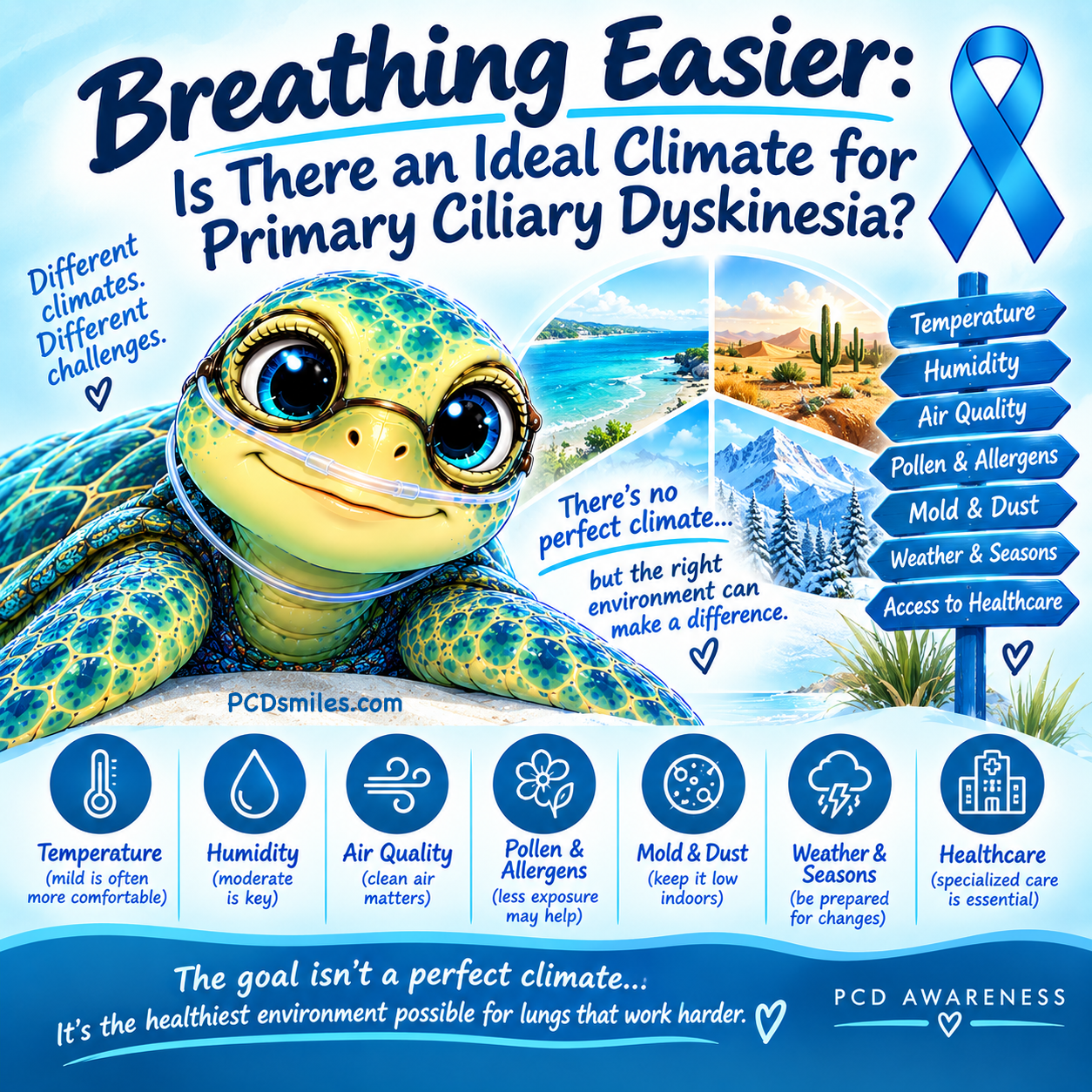
There is no scientifically proven "perfect climate" for PCD, and moving to a particular climate cannot cure or stop the underlying disease.
Instead, certain environmental conditions may be more comfortable or less irritating for some individuals than others.
The ideal environment is likely to be the one that minimizes personal triggers while providing clean air, manageable weather, and access to excellent medical care.
What Makes a Climate Easier or Harder to Live With?
There are several environmental factors worth considering:
- Temperature
- Humidity
- Air quality
- Pollen and allergens
- Mold
- Dust and particulate matter
- Severe weather and seasonal changes
And perhaps most importantly:
- Access to specialized medical care
Let's look at each one.
Temperature: Avoiding Extremes May Help
Extreme temperatures can be challenging for people with chronic respiratory disease.
Very cold air can irritate the airways and may make breathing feel more difficult. Cold, dry air can also be uncomfortable for some people with respiratory disease.
On the other end of the spectrum, extreme heat can place additional stress on the body, particularly when combined with high humidity or poor air quality.
For some people with PCD, a mild or temperate climate may therefore feel more comfortable than an environment with dramatic temperature extremes.
But this is highly individual.
One person may feel significantly better during warm weather while another may tolerate cooler temperatures without much difficulty.
There is no specific temperature range that has been established as medically ideal for everyone with PCD.
Humidity: Finding the Middle Ground
Humidity is one of the most interesting climate factors for PCD.
Mucus that becomes thick and difficult to clear is already a major problem when cilia aren't functioning properly.
Very dry air can make the nose, throat, and airways feel dry and irritated.
But extremely humid environments have their own problems.
High humidity can encourage the growth of mold and dust mites, which can be important respiratory irritants for some people.
The goal isn't necessarily "more humidity."
It's finding an environment that keeps the air comfortable without creating excessive moisture and mold indoors.
For many people, moderate indoor humidity may be more comfortable than either extremely dry or extremely humid conditions.
Indoor humidity can often be managed with:
- Humidifiers when appropriate - usually NOT recommended in PCD care
- Dehumidifiers when necessary
- Good ventilation
- Proper bathroom ventilation
- Promptly addressing water leaks
- Preventing indoor mold growth
A humidity monitor can also help people understand what is actually happening inside their homes rather than relying on how the air feels.
What About Living Near the Ocean?
The idea of coastal living is particularly appealing to people with mucus-clearing disorders.
Some people report that they feel better near the ocean, and the moist maritime environment may feel more comfortable to certain individuals.
But there is an important misconception to address:
Living near the ocean is not the same as receiving a hypertonic saline treatment.
The amount and concentration of salt particles naturally present in outdoor coastal air are not equivalent to the controlled saline solutions used in medical nebulizer treatments.
So while someone may genuinely feel better near the ocean, we shouldn't assume that breathing sea air is directly thinning their lung mucus in the same way as prescribed inhaled saline.
Coastal environments can also have drawbacks, including:
- High humidity
- Mold
- Seasonal allergens
- Storms
- Air pollution in some coastal cities
- Wildfire smoke in some regions
The ocean itself doesn't automatically make a location healthier for someone with PCD.
What About Dry Desert Climates?
Warm, dry climates are sometimes attractive to people with chronic respiratory conditions.
A desert environment may offer:
- Fewer humid days
- Less indoor moisture
- Reduced mold growth in some circumstances
- Warm temperatures
- Fewer extreme cold-weather exposures
But extremely dry air can also be uncomfortable.
For someone already dealing with thick respiratory secretions, excessive dryness may contribute to irritation and discomfort.
Desert environments can also have:
- Dust
- Wind-blown particles
- Seasonal allergens
- Wildfire smoke
- Air pollution
Dust and particulate pollution can be especially problematic for lungs that already have difficulty clearing inhaled particles.
So "dry" does not automatically mean "better."
Cold Weather and PCD
Winter can be challenging for many people with chronic respiratory disease.
Cold air may irritate the airways, while spending more time indoors can increase exposure to respiratory viruses.
Heating systems can also make indoor air extremely dry.
And in cold, damp climates, indoor moisture can contribute to mold problems.
However, it's important not to say that cold weather itself causes infections or that every person with
PCD will have worse symptoms during winter.
Respiratory infections, indoor air quality, allergens, individual sensitivity, and seasonal changes can all contribute to how someone feels.
For a person with PCD, the combination of cold temperatures + respiratory viruses + poor indoor air quality + reduced activity may be more important than temperature alone.
Air Quality May Matter More Than the Weather
If you're thinking about moving because of PCD, don't look only at the temperature.
Air quality may be one of the most important environmental factors to consider.
PCD already makes it harder for the respiratory tract to clear inhaled particles.
Adding large amounts of:
- Fine particulate matter
- Smoke
- Vehicle pollution
- Industrial pollution
- Dust
- Wildfire smoke
can add another burden to the lungs.
A warm location with consistently poor air quality may be a much less comfortable environment than a cooler location with clean air.
This is particularly important in areas affected by seasonal wildfire smoke.
Before considering a move, look at the area's year-round air-quality patterns, not just its average temperature.
Don't Forget Pollen and Allergens
A climate that feels wonderful to one person may be miserable for another.
Seasonal pollen can trigger significant upper-airway symptoms in people with allergies or asthma.
Trees, grasses, weeds, and molds vary dramatically by geographic region.
If allergies are already a major problem, a location with high levels of a person's specific triggers may not be an ideal choice—even if the temperature is perfect.
This is another reason there is no universal "PCD climate."
Your personal triggers matter.
Mold Deserves Special Attention
Mold can become an environmental problem in persistently damp homes.
For someone with chronic respiratory disease, significant mold exposure may contribute to respiratory symptoms and should be addressed.
This doesn't mean people with PCD need to avoid every humid climate.
It means that the condition of the home matters.
A well-maintained, dry home with good ventilation may be far more important than simply looking at the humidity percentage of an entire city.
When evaluating a potential home, consider:
- Water damage
- Basement moisture
- Visible mold
- Ventilation
- Bathroom exhaust
- HVAC maintenance
- Indoor humidity
- History of flooding
Sometimes the best climate can be undermined by a poorly maintained house.
Seasonal Changes and Severe Weather
Climate isn't just about average temperature.
Rapid weather changes, thunderstorms, high winds, wildfire smoke, dust storms, and other environmental events can temporarily affect air quality.
People with PCD may want to pay attention to local air-quality alerts and environmental conditions, particularly during:
- Wildfires
- Dust events
- High-pollution days
- Heavy pollen seasons
- Severe weather events
When air quality is poor, limiting exposure and following guidance from local health authorities can be an important part of protecting the lungs.
So What Is the "Ideal" PCD Climate?
There isn't one.
But if someone with PCD is trying to identify an environment that may be more comfortable for their individual respiratory health, several characteristics may be worth considering:
|
Environmental factor |
Potentially favorable characteristics |
|
Temperature |
Mild conditions that the individual tolerates well |
|
Humidity |
Moderate indoor humidity without persistent dampness |
|
Air quality |
Low pollution and low particulate exposure |
|
Mold |
Low indoor moisture and well-maintained housing |
|
Pollen |
Lower exposure to the individual's known allergens |
|
Dust |
Minimal dust and particulate exposure |
|
Smoke |
Low exposure to wildfire and other smoke |
|
Weather extremes |
Fewer periods of extreme heat, cold, or severe weather |
|
Healthcare |
Reliable access to PCD-experienced specialists |
The last one may be the most important.
Medical Care May Matter More Than Climate
Imagine two locations.
One has beautiful weather, but the nearest PCD-experienced pulmonologist is several hours away.
The other has weather that isn't perfect, but it provides convenient access to specialists, pulmonary testing, respiratory cultures, ENT care, imaging, and emergency services.
For someone living with a lifelong, multisystem disease like PCD, access to appropriate medical care may outweigh climate preferences.
A move should never be based on weather alone.
Consider:
- Access to a PCD-experienced pulmonologist
- Adult or pediatric specialty care
- Access to airway-clearance support
- Respiratory cultures
- ENT and audiology services
- Emergency medical care
- Pharmacy access
- Insurance considerations
- Transportation
- Family and social support
A comfortable climate is helpful.
Excellent medical care is essential.
Can Moving Improve PCD?
It may improve how someone feels, particularly if their current environment exposes them to triggers that worsen their symptoms.
But moving does not correct the underlying ciliary dysfunction.
PCD remains a genetic condition regardless of where someone lives.
A new climate also cannot replace:
- Daily airway clearance
- Appropriate respiratory medications
- Treatment of infections
- Regular monitoring
- Vaccinations
- Exercise when appropriate
- Good nutrition
- Adequate hydration
- Specialized PCD care
Climate should be viewed as a supporting environmental factor—not a treatment or cure.
The Most Important Climate Is the One Your Body Tolerates
There is no magical coastline, desert, mountain town, or warm-weather destination that is guaranteed to make PCD better.
One person may thrive near the ocean.
Another may feel better somewhere dry.
Someone else may do perfectly well in a cool, temperate environment.
And someone who has lived with PCD for years may already know exactly which environmental conditions make their symptoms worse.
That personal experience matters.
If you're considering a move, pay attention to patterns in your own symptoms and discuss major lifestyle or relocation decisions with your healthcare team.
The goal isn't to find a perfect climate. It's to create the healthiest environment possible for lungs that already have to work harder.
For people with PCD, that may mean clean air, manageable temperatures, controlled indoor humidity, fewer environmental triggers—and, most importantly, access to the specialized care needed to protect lung health for the long term.
Be sure to join us tomorrow for another conversation about primary ciliary dyskinesia.
Join our Facebook group Turtle Talk Café today.
We have several ways that you can donate to PCD Smiles;
- Visit Smile E. Turtle's Amazon Wishlist
- For more information on how you can donate, please visit our "Donation" page to check out our "Do & Don't policies.
- Or sponsor a PCD Smiles cheer package today!
- To shop for your “Official” turtle care ribbon gear today, visit PCD Style
Thank you for your consideration!
Medical Disclaimer
This article is intended for general educational and informational purposes only and is not a substitute for professional medical advice, diagnosis, or treatment. Infection risks and appropriate prevention strategies can vary considerably between people with PCD based on their lung health, respiratory cultures, treatments, age, and other medical conditions.
This article is for educational purposes and does not establish that over-thinning mucus causes increased infection risk in people with PCD. Responses to airway-clearance and mucoactive therapies vary. Any changes to prescribed treatments should be discussed with a healthcare professional familiar with PCD.
Cleaning and disinfection recommendations for respiratory equipment can also vary by device and manufacturer. Always follow the instructions provided by your healthcare team and equipment manufacturer.
Do not start, stop, or change medications, airway-clearance treatments, infection-control practices, or other aspects of your medical care based solely on this article. If you have PCD and are concerned about an infection, worsening respiratory symptoms, or possible exposure to a pathogen, contact your PCD or respiratory healthcare team for individualized guidance.
If you are experiencing severe or rapidly worsening breathing difficulties or another medical emergency, seek urgent medical attention.